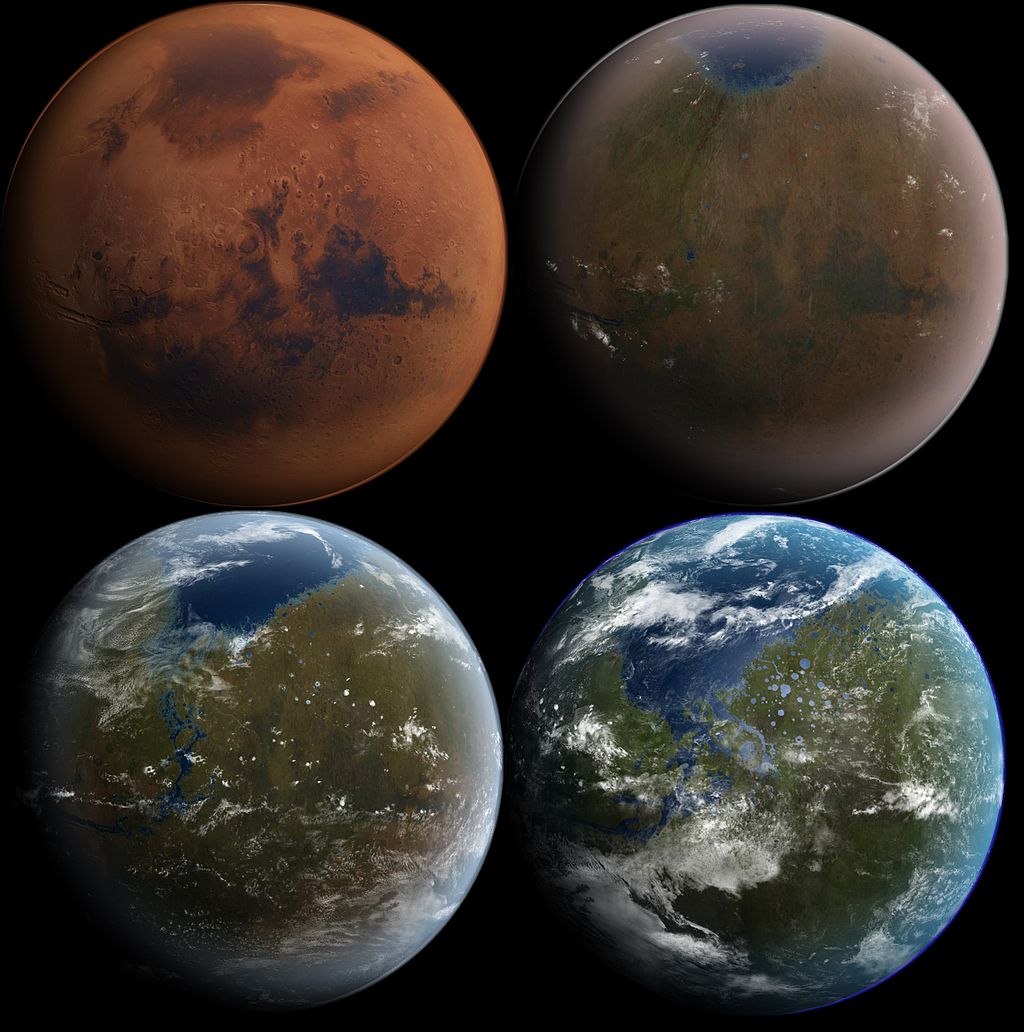
Terraforming Mars
The hypothetical terraforming of Mars would constitute a planetary engineering project or concurrent projects, with the goal of transforming the planet from one hostile to terrestrial life to one that can sustainably host humans and other lifeforms free of protection or mediation. The process would presumably involve the rehabilitation of the planet's extant climate, atmosphere, and surface through a variety of resource-intensive initiatives, and the installation of a novel ecological system or systems.
Justifications for choosing Mars over other potential terraforming targets include the presence of water, and a geological history that suggests it once harbored a dense atmosphere similar to Earth’s. Hazards and difficulties include low gravity, low light levels relative to Earth’s, and the lack of a magnetic field.
Objections to the project include general ethical concerns about terraforming and the considerable cost that such an undertaking would involve. Reasons for terraforming the planet include allaying concerns about resource use on Earth and arguments that the modification and subsequent or concurrent settling of other planets decreases the odds of humanity's extinction.
Disagreement exists about whether, with sufficient resources, current technology could render the planet habitable.
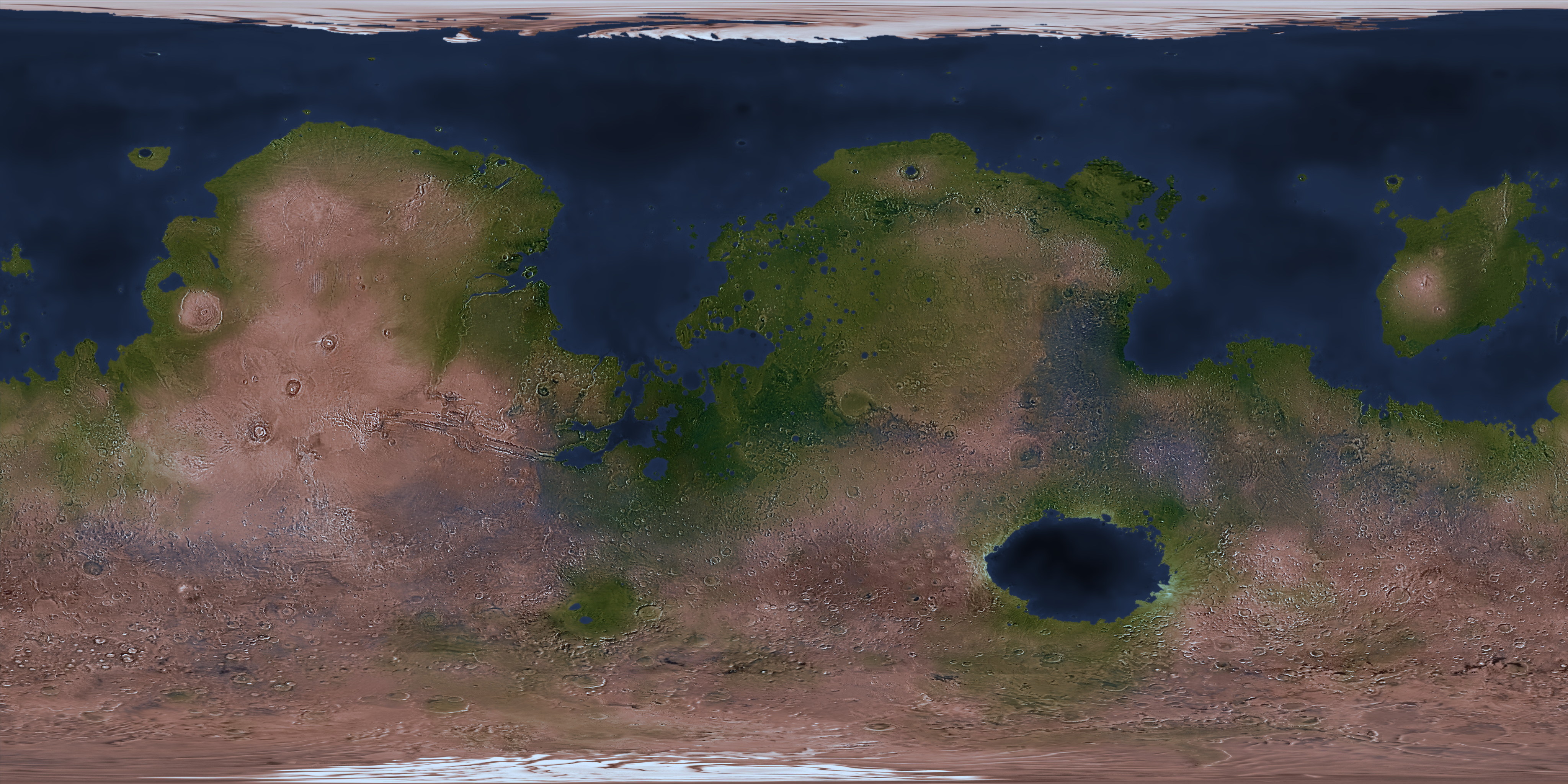
Map of Terraformed Mars
Low gravity and pressure
The surface gravity on Mars is 38% of that on Earth. It is not known if this is enough to prevent the health problems associated with weightlessness.
Mars's CO atmosphere has about 1% the pressure of the Earth's at sea level. It is estimated that there is sufficient CO ice in the regolith and the south polar cap to form a 30 to 60 kilopascals kPa (4.4 to 8.7 psi) atmosphere if it is released by planetary warming. The reappearance of liquid water on the Martian surface would add to the warming effects and atmospheric density, but the lower gravity of Mars requires 2.6 times Earth's column airmass to obtain the optimum 100 kPa (15 psi) pressure at the surface. Additional volatiles to increase the atmosphere's density must be supplied from an external source, such as redirecting several massive asteroids containing ammonia (NH
3) as a source of nitrogen.
Breathing on Mars
Current conditions in the Martian atmosphere, at less than 1 kPa (0.15 psi) of atmospheric pressure, are significantly below the Armstrong limit of 6 kPa (0.87 psi) where very low pressure causes exposed bodily liquids such as saliva, tears, and the liquids wetting the alveoli within the lungs to boil away. Without a pressure suit, no amount of breathable oxygen delivered by any means will sustain oxygen-breathing life for more than a few minutes.[16][17] In the NASA technical report Rapid (Explosive) Decompression Emergencies in Pressure-Suited Subjects, after exposure to pressure below the Armstrong limit, a survivor reported that his "last conscious memory was of the water on his tongue beginning to boil".[17] In these conditions humans die within minutes unless a pressure suit provides life support.
If Mars' atmospheric pressure could rise above 19 kPa (2.8 psi), then a pressure suit would not be required. Visitors would only need to wear a mask that supplied 100% oxygen under positive pressure. A further increase to 24 kPa (3.5 psi) of atmospheric pressure would allow a simple mask supplying pure oxygen.[18][clarification needed] This might look similar to mountain climbers who venture into pressures below 37 kPa (5.4 psi), also called the death zone, where an insufficient amount of bottled oxygen has often resulted in hypoxia with fatalities. However, if the increase in atmospheric pressure was achieved by increasing CO2 (or other toxic gas) the mask would have to ensure the external atmosphere did not enter the breathing apparatus. CO2 concentrations as low as 1% cause drowsiness in humans. Concentrations of 7% to 10% may cause suffocation, even in the presence of sufficient oxygen.